
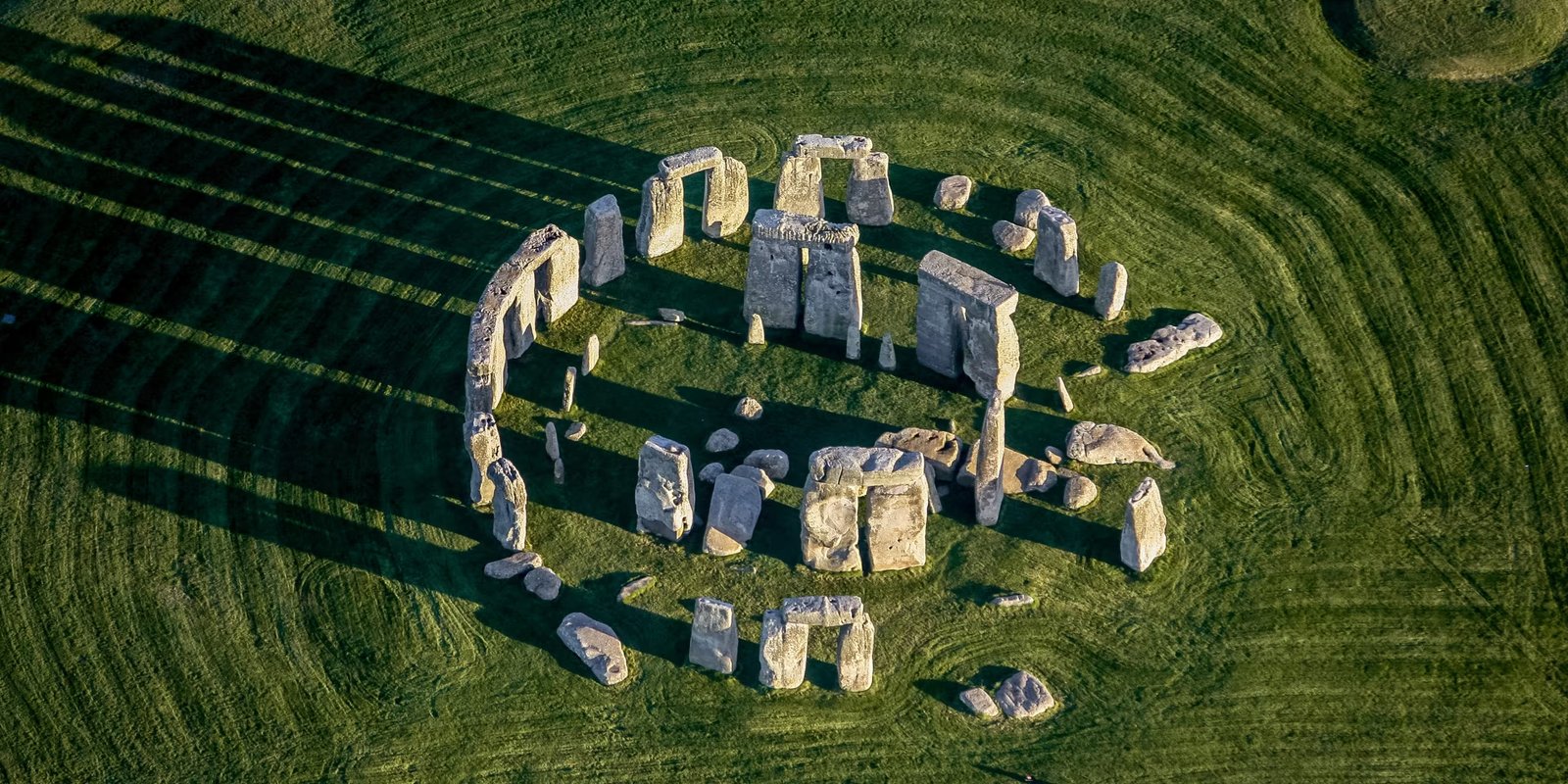
Few prehistoric monuments capture the imagination quite like Stonehenge. Rising from the plains of southern England, this mysterious circle of towering stones has fascinated historians, archaeologists, and travelers for centuries. Built thousands of years before modern engineering, Stonehenge remains one of the most iconic and enigmatic structures in human history.
Stonehenge’s origins date back to around 3000 BCE, making it older than many famous ancient landmarks, including the pyramids of Giza. However, the monument was not constructed all at once. Archaeological evidence suggests that Stonehenge was built in several phases over roughly 1,500 years.
The earliest version of the site consisted of a circular earthwork enclosure with a ditch and bank. Over time, massive stones were added, arranged in rings and horseshoe shapes. The most famous elements are the trilithons—pairs of vertical stones supporting a horizontal lintel.
What makes this achievement remarkable is the sheer scale of the stones. Some weigh over 25 tons, and many were transported from quarries dozens or even hundreds of kilometers away.
Researchers believe the larger stones, known as sarsens, were brought from the Marlborough Downs about 25 kilometers (15 miles) away. The smaller stones, called bluestones, likely originated from the Preseli Hills in Wales—nearly 250 kilometers (155 miles) from the site.
How prehistoric people managed this feat without modern machinery remains a topic of debate. Some theories suggest that the stones were dragged on wooden sledges, rolled on logs, or transported by river rafts. Experiments by archaeologists have shown that large teams using simple tools could move these massive stones surprisingly effectively.
One of the most intriguing aspects of Stonehenge is its alignment with celestial events. The monument is famously oriented toward the sunrise of the summer solstice, the longest day of the year.
Every June, thousands of visitors gather to watch the sun rise precisely over the Heel Stone, casting light into the center of the monument. This alignment suggests that the builders had a sophisticated understanding of the movement of the sun and seasons.
Some researchers believe Stonehenge may have served as an ancient astronomical calendar, helping early agricultural societies track seasonal changes.
Archaeological excavations have revealed that Stonehenge was more than just a circle of stones. The surrounding landscape contains burial mounds, ceremonial avenues, and other prehistoric structures.
Human remains discovered at the site suggest that Stonehenge was used as a cremation cemetery during its earliest phases. This indicates that it likely held deep spiritual or ritual significance for the communities that built and used it.
Nearby monuments such as Durrington Walls suggest that large gatherings and ceremonies may have taken place in the region.
Despite centuries of study, the exact purpose of Stonehenge remains uncertain. Scholars have proposed many theories, including that it functioned as:
A religious temple or sacred ceremonial site
An astronomical observatory used to track celestial cycles
A burial ground for elite members of ancient society
A symbol of unity for different prehistoric communities
It is possible that Stonehenge served several of these functions at different times throughout its long history.
Today, Stonehenge is recognized as one of the most important archaeological sites in the world and is protected as part of the UNESCO World Heritage Site known as the Stonehenge, Avebury and Associated Sites.
Millions of visitors travel to the English countryside each year to see the monument and ponder the ingenuity of its ancient builders.
Even after thousands of years of research, Stonehenge continues to inspire curiosity. It stands not only as a relic of prehistoric engineering but also as a reminder of humanity’s enduring fascination with the sky, the seasons, and the mysteries of the past.
STAY INFORMED
No fluff. Just sharp takes on AI, marketing, and what's working right now.
What best describes you?
What stage are you operating at?
Which AI signals matter most to you? (select all that apply)